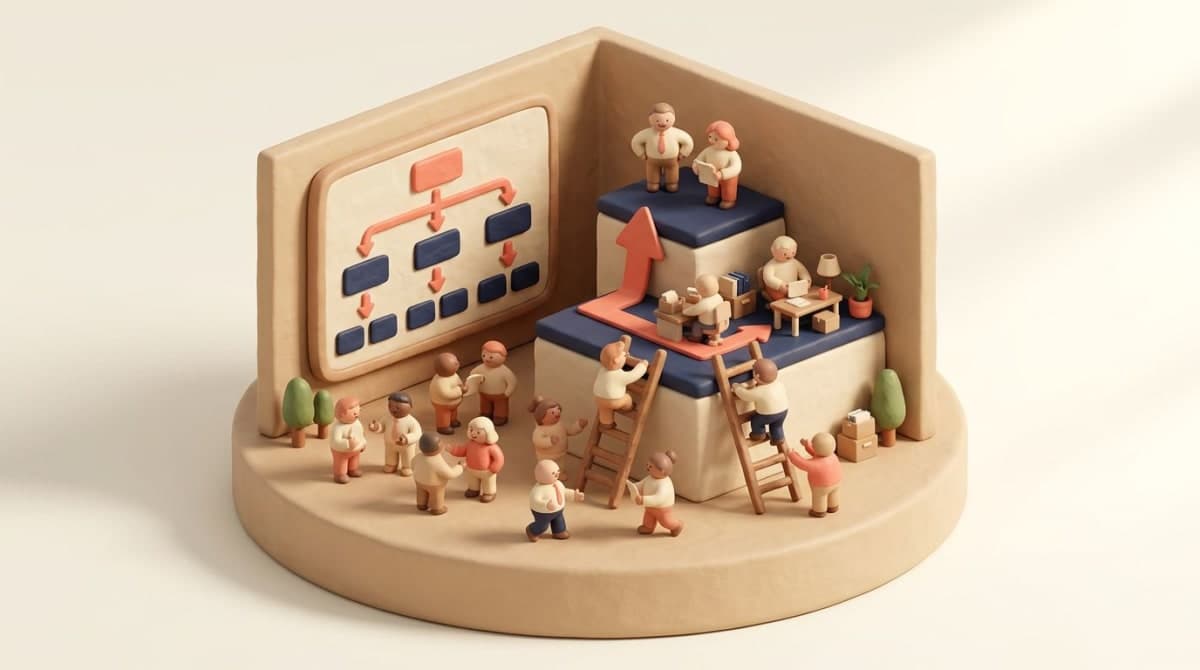
Succession planning is the process of identifying and developing employees who can step into critical roles when someone leaves, gets promoted, or takes extended leave. For small teams, it's not a corporate luxury — it's a survival strategy.
According to SHRM, only 14% of organizations have a robust succession plan in place. That number drops even further for companies under 100 employees. Yet small teams are the ones hit hardest when a key person walks out the door.
This guide breaks down a practical succession planning process built specifically for growing teams of 5–100 people — no enterprise jargon, no consultants required.

What Is Succession Planning?
Succession planning is a structured approach to preparing your team for leadership transitions. It answers one question: if this person left tomorrow, who would take over?
Unlike replacement planning (which is reactive), succession planning is proactive. You're building a pipeline of capable people before you need them — not scrambling after the fact.
For a 15-person startup, that might mean cross-training your only developer lead. For a 60-person company, it could involve formal development tracks for three department heads. The scale changes, but the principle stays the same.
Why Small Teams Need Succession Planning More Than Big Companies
Large enterprises can absorb the loss of a single person. They have layers of management, deep benches, and recruiting budgets that can fill roles fast. Small teams don't have those buffers.
Here's what makes small-team succession planning different — and more urgent:
| Factor | Enterprise (500+) | Small Team (5–100) |
|---|---|---|
| Single points of failure | Rare — roles overlap | Common — one person owns entire functions |
| Recruiting timeline | 2–4 weeks (established pipeline) | 4–12 weeks (starting from scratch) |
| Knowledge concentration | Documented across systems | Often lives in one person's head |
| Revenue impact of vacancy | Distributed | Immediate and severe |
| Cost of bad hire | Absorbable | Potentially company-threatening |
A 2025 study found that companies with formal succession plans are 2.5 times more likely to outperform competitors financially. For small teams operating on thin margins, that gap between prepared and unprepared isn't just inconvenient — it's existential.
Consider this scenario: A 30-person marketing agency has one senior account manager who handles their three biggest clients. She gives two weeks' notice. Without succession planning, the founder is now personally managing $400K in client relationships while simultaneously trying to hire a replacement. Revenue dips. Client confidence wavers. Two of the three accounts start looking elsewhere.
With a succession plan, her backup — trained over the past six months — steps in on day one. The transition is smooth. Clients barely notice.
The 5-Step Succession Planning Process

Step 1: Identify Your Critical Roles
Not every role needs a succession plan. Start with the positions where a vacancy would cause the most damage.
Ask yourself three questions about each role:
- Revenue impact: Would losing this person directly affect income within 30 days?
- Knowledge concentration: Does this person hold information nobody else has?
- Replaceability: How long would it take to hire and onboard a replacement externally?
For most small teams, you'll end up with 3–7 critical roles. Typical examples include the founder/CEO, head of engineering, lead salesperson, senior operations manager, and whoever manages your biggest client relationships.
Don't overthink this step. If the thought of someone leaving makes your stomach drop, that's a critical role.
Step 2: Assess Your Current Talent
Once you know which roles matter most, evaluate who on your team could potentially fill them. This is where a simple talent assessment matrix helps.
Rate each potential successor on two dimensions:
- Performance: How well do they execute in their current role? (Low / Medium / High)
- Potential: Could they grow into a bigger role within 12–18 months? (Low / Medium / High)
Here's what a basic matrix looks like for a 25-person company:
| Critical Role | Current Holder | Potential Successor | Performance | Potential | Readiness |
|---|---|---|---|---|---|
| Head of Product | Sarah K. | James L. | High | High | 6–12 months |
| Lead Engineer | Mike R. | Priya S. | High | Medium | 12–18 months |
| Sales Director | Ana T. | David C. | Medium | High | 12+ months |
| Ops Manager | Chris B. | No internal candidate | — | — | External hire needed |
The "no internal candidate" finding is just as valuable as identifying a strong successor. It tells you where to focus hiring efforts or where to start cross-training immediately.
Step 3: Build Individual Development Plans
For each identified successor, create a specific development plan. This isn't a vague promise of "more responsibility" — it's a concrete roadmap with timelines.
A strong development plan for a small team includes:
Skill gaps to close. Be specific. "Needs to learn financial modeling" is actionable. "Needs leadership skills" is not.
Stretch assignments. Give potential successors projects that expose them to the critical role's responsibilities. Let them run a quarterly planning session, manage a client relationship solo, or lead a cross-functional project.
Mentorship pairings. Connect the successor with the current role holder for regular knowledge-sharing sessions. Even 30 minutes weekly makes a significant difference over six months.
Timeline and milestones. Set quarterly checkpoints to review progress. "By Q2, Jamie should be able to run the sales pipeline review independently."
Track these plans in your people management system and revisit them during one-on-one meetings.
Step 4: Document Critical Knowledge

Small teams suffer most from what HR professionals call "institutional knowledge loss." When your only accountant leaves and all the vendor payment schedules, tax filing quirks, and approval workflows live in her head, you're starting from zero.
Build a knowledge capture habit across your team:
- Process documentation: For every critical role, document the top 10 recurring tasks step-by-step. Store these in a shared document system where successors can access them.
- Relationship maps: Who are the key external contacts? Clients, vendors, partners — create a list with context notes (preferences, history, communication style).
- Decision logs: Record why major decisions were made, not just what was decided. This context is irreplaceable.
- Access and credentials: Maintain a secure record of all systems, tools, and accounts each role manages.
According to SHRM's research on succession planning, retaining institutional knowledge is one of the four strategic imperatives that make succession planning essential — especially as experienced workers retire and take decades of tacit knowledge with them.
Step 5: Review and Update Quarterly
A succession plan that sits in a drawer is worthless. Schedule quarterly reviews to reassess:
- Have any critical roles changed?
- Have successors progressed or plateaued?
- Are development plans on track?
- Has anyone new joined who could be a successor candidate?
The best time to do this is during your performance review cycle. You're already evaluating talent — add 15 minutes to discuss succession readiness.
How to Identify High-Potential Employees
Not every strong performer is a future leader. High-potential employees — the ones who can genuinely grow into bigger roles — share a specific set of traits that go beyond doing their current job well.
Here's what to look for:
Learning agility. They pick up new skills quickly and seek out unfamiliar challenges. When thrown into a situation they haven't faced before, they figure it out rather than freezing.
Ownership mentality. They don't wait to be told what to do. They see problems and start solving them. They care about outcomes, not just task completion.
Influence without authority. They can get colleagues on board with an idea even when they have no formal power. This is the single strongest predictor of future leadership success.
Self-awareness. They know their weaknesses, ask for feedback, and act on it. Employees who think they're already perfect rarely grow into leadership roles.
Resilience under pressure. When things go sideways — and at a small company, they always do — these people get calmer, not more frantic.
A practical way to spot high-potential employees is the "3E framework" used by many talent development professionals:
- Experience: Have they succeeded in progressively more complex assignments?
- Exposure: Have they built relationships across teams and functions?
- Education: Have they invested in their own development (formal or informal)?
Employees who score high across all three are your succession planning priorities.
Succession Planning Template
Use this template to document your succession plan. Adapt it to your team size — a 10-person company might only need one page.

Role Assessment Worksheet
Critical Role: _______________
Current Holder: _______________
Why this role is critical: _______________
Impact if vacant for 30+ days: _______________
Successor Candidates
| Candidate | Current Role | Strengths | Gaps | Readiness Timeline |
|---|---|---|---|---|
| ___________ | ___________ | ___________ | ___________ | ___________ |
| ___________ | ___________ | ___________ | ___________ | ___________ |
Development Plan (Primary Successor)
Skill gaps to address:
Stretch assignments (next 6 months):
Mentorship: _______________ meets with _______________ every _______________
Quarterly milestones:
- Q1: _______________
- Q2: _______________
- Q3: _______________
- Q4: _______________
Emergency Coverage Plan
If this role is vacant tomorrow:
- Day 1–7: _______________ handles urgent responsibilities
- Week 2–4: _______________ takes over key functions
- Month 2+: Begin external search if needed
Critical knowledge documented? ☐ Yes ☐ Partially ☐ No
Key relationships to transfer: _______________
Review Schedule
Last reviewed: _______________
Next review: _______________
Copy this for each critical role and store it somewhere accessible — your people management tool, a shared drive, or even a printed binder in the founder's office.
Common Succession Planning Mistakes
Even well-intentioned succession planning efforts fail when teams fall into these traps.
Mistake 1: Only planning for the CEO. While founder succession matters, small teams should plan for every critical role. Your head of engineering leaving can be just as disruptive as the CEO.
Mistake 2: Confusing performance with potential. Your top salesperson might be brilliant at closing deals but terrible at managing a sales team. High performance in the current role doesn't automatically mean readiness for the next one.
Mistake 3: Keeping the plan secret. Some founders worry that discussing succession planning will make employees think they're planning to leave. The opposite is true — transparency about growth paths improves retention. Employees who see a future at your company stay longer.
Mistake 4: Skipping the development step. Identifying successors without investing in their growth is just making a list. Without active development — stretch assignments, mentorship, skill-building — potential successors won't be ready when you need them.
Mistake 5: "Set it and forget it." Teams change. People grow, leave, or change direction. A succession plan from 18 months ago is probably outdated. Quarterly reviews keep it relevant.
Mistake 6: No emergency plan. Succession planning is mostly about long-term development, but you also need a "hit by a bus" plan. Who covers for each critical role today, even imperfectly? That's different from who'll be ready in 12 months.
Best Tools for Succession Planning

You don't need expensive enterprise software to run succession planning. Here's what actually works at different team sizes:
5–15 employees: A simple spreadsheet or document works fine. Use the template above, store it in your team's shared drive, and review it quarterly. The process matters more than the tool.
15–50 employees: An HR platform like Tiny Team helps you centralize employee profiles, track performance reviews, and document development plans in one place — without the per-seat pricing that punishes growing teams. Pair it with your existing org chart for visual succession mapping.
50–100 employees: At this size, you likely need dedicated performance and people management features. Look for tools that connect performance reviews with development tracking so succession data stays current rather than living in a forgotten spreadsheet.
Regardless of team size, the fundamentals don't change: identify critical roles, assess talent, develop successors, document knowledge, and review regularly.
Frequently Asked Questions
When should a small team start succession planning?
Start as soon as you have 5+ employees and at least one person whose departure would significantly disrupt operations. You don't need a formal program — even a simple document outlining backup coverage for critical roles is a strong first step.
How is succession planning different from replacement planning?
Replacement planning is reactive: someone leaves, and you find a substitute. Succession planning is proactive: you develop people continuously so they're ready before a vacancy happens. Replacement planning fills a gap. Succession planning prevents one.
What are the 4 stages of succession planning?
The four core stages are: (1) identifying critical roles, (2) assessing current talent and potential successors, (3) developing successors through mentorship and stretch assignments, and (4) reviewing and updating the plan regularly. Some frameworks add a fifth stage — knowledge documentation — which is especially important for small teams.
How do you handle succession planning when there's no internal candidate?
This is common in small teams. When no one is ready internally, you have three options: hire externally with succession potential in mind, partner with the current role holder to cross-train existing staff, or restructure the role so responsibilities are shared across multiple people.
Does succession planning affect employee retention?
Yes — positively. Research from SHRM shows that employees who see clear development paths are twice as likely to stay long-term. Succession planning signals that you're invested in people's growth, which directly combats the top reason people leave: lack of career advancement.
How often should you update a succession plan?
Review your succession plan quarterly, ideally alongside your performance review cycle. Major updates should happen whenever there's a significant change — someone leaves, a new hire joins, or the business strategy shifts. At minimum, do a full review annually.
![Employee Engagement Survey: 50+ Questions [2026]](/_next/image?url=https%3A%2F%2Fres.cloudinary.com%2Fdyqvdvwow%2Fimage%2Fupload%2Fw_1200%2Cq_auto%2Cf_auto%2Ftinyteam-blog%2Fg6sqtrdetjz3kvfgrf7l.jpg&w=1200&q=75)