Workplace culture is the shared beliefs, values, and behaviors that define how people work together in your organization. It's what happens when nobody's looking—how decisions get made, how people treat each other, and what your team actually prioritizes versus what's written on the wall.
For small teams, culture isn't a nice-to-have. Research by Great Place to Work shows companies with strong cultures see 40% lower turnover and 2.3x higher revenue growth. When you're competing for talent against companies 10x your size, workplace culture becomes your competitive advantage.
The good news? Small teams have natural advantages. Direct relationships, faster decisions, and the agility to adjust quickly when something isn't working.
What Is Workplace Culture?
Workplace culture encompasses everything from visible elements—office design, meeting styles, dress code, communication tools—to deeper behavioral norms around collaboration, feedback, and conflict resolution. Underneath both layers sit the values your organization truly prioritizes when making difficult decisions.
The critical distinction: your values are what you aspire to be; your culture is what you actually are. Many companies have impressive value statements but toxic cultures because there's a gap between intention and reality. When the company says "we value transparency" but leadership makes decisions behind closed doors, employees notice the gap immediately.
Enterprise culture guides focus on corporate initiatives, executive committees, and formal programs. Small teams need practical, day-one approaches that work with limited resources and flat hierarchies. A 12-person startup can build stronger culture than a 10,000-person corporation because every single person has direct impact on the team experience. Your challenge isn't bureaucracy—it's intentionality. Every hire, every meeting, every decision you make either strengthens or erodes your culture.
Why Workplace Culture Matters for Small Teams
Small teams feel culture issues immediately and intensely. In a 50-person company, one toxic team member affects everyone. Poor communication habits spread like wildfire. But positive culture also amplifies faster—and that's your edge.
| Impact Area | How Culture Affects It |
|---|---|
| Talent retention | Replacing a team member costs 50-200% of annual salary. Strong culture is your best retention strategy. |
| Decision speed | Clear cultural norms reduce constant escalation to leadership. |
| Customer experience | Internal culture directly shapes how your team treats customers. Engaged employees provide better service. |
| Innovation | Psychological safety drives creative problem-solving. Small teams can create this faster than any enterprise. |
| Recruiting | Happy employees refer quality candidates. Unhappy ones warn their networks to stay away. In small markets, reputation spreads quickly. |
When you can't match big-company salaries, culture becomes your differentiator. Top performers often choose environments where they can grow, be valued, and do meaningful work over a marginally higher paycheck at a soulless corporation.
4 Types of Workplace Culture

Understanding culture types helps you identify your current state and decide where you want to go. Most organizations blend elements from multiple types.
1. Collaborative Culture
Team-first mentality, consensus decision-making, shared goals, open communication. Produces high employee engagement and strong teamwork but can be slow to make decisions. Buffer demonstrates this with transparent salary formulas and public revenue dashboards where the entire team weighs in on major choices.
2. Results-Driven Culture
Performance focus, clear accountability, merit-based recognition. Delivers high productivity and rewards top performers but can become cutthroat if guardrails aren't in place. Best for sales organizations and fast-growth startups where speed matters.
3. Innovation Culture
Experimentation is encouraged, failure is treated as learning, and autonomy is given generously. Drives breakthrough thinking but can struggle with execution and operational excellence. 3M's "15% time" policy—allowing employees to pursue personal projects—has produced some of their most important innovations.
4. Customer-Centric Culture
Customer needs drive every decision. Builds strong loyalty and gives teams a clear decision-making framework. Zappos built legendary customer service by empowering employees to do whatever it takes to make customers happy, including spending hours on a single support call.
Most successful small teams blend collaborative and results-driven elements while layering in innovation or customer focus based on their market position.
Signs of a Healthy vs Toxic Workplace Culture

Recognizing culture health early helps you identify what to reinforce and what needs urgent attention. The difference between healthy and toxic workplace culture often comes down to small, daily behaviors that compound over time. Here's what to watch for on both sides.
Healthy Signals
- People share ideas freely without fear of judgment or retaliation
- Mistakes are treated as learning opportunities, not blame targets
- Flexible policies that trust employees to manage their own time
- Low voluntary turnover and high employee referral rates
- Constructive feedback flows naturally in both directions—including upward to leadership
- Credit is shared and recognition is given frequently, not just at annual reviews
Toxic Warning Signs
- Important information is withheld or shared selectively among inner circles
- Burnout is common and even celebrated as "dedication" or "hustle"
- Gossip and rumors spread faster than official communication
- High turnover, especially among your best performers
- Leadership says one thing but consistently does another
- People avoid difficult conversations or escalate unnecessarily instead of resolving directly
Early intervention is key. Small teams can address toxic patterns in weeks. Large organizations often need years to change ingrained cultural problems.
How to Build a Strong Workplace Culture (Step by Step)

Building intentional culture requires consistent action. Here's a practical timeline.
Step 1: Define Your Core Values (Week 1)
Don't just brainstorm values—identify what already drives your best decisions. Ask each team member to describe 2-3 moments when they felt most proud of the team, then look for patterns across responses.
Make values actionable. Instead of "integrity," try "we keep our commitments to each other and our customers." Instead of "innovation," try "we experiment quickly and learn from failures." Specific language guides behavior; abstract words decorate walls.
Step 2: Align Leadership Behavior (Week 2)
Culture is what leadership does, not what they say. Identify specific behaviors that demonstrate your values—like sharing monthly financials for transparency, or publicly owning project failures for accountability.
A 25-person marketing agency in Portland discovered their "open door policy" was meaningless because the CEO never actually acted on feedback. They switched to anonymous monthly surveys with published results and concrete response plans. Within three months, engagement scores jumped 40%.
Create accountability by meeting weekly with leadership to discuss how you're modeling values. Ask your team for direct feedback on leadership consistency—and actually change based on what you hear.
Step 3: Hire for Cultural Fit (Ongoing)
Skills can be taught; values alignment is much harder to change. Add culture-focused interview questions to every hiring process:
- "Tell me about a time you took ownership of a mistake"
- "What type of work environment brings out your best performance?"
- "How do you handle competing priorities under pressure?"
- "Describe a situation where you disagreed with a decision. How did you handle it?"
Include team members in interviews—cultural fit is easier to assess when multiple people interact with candidates in different settings.
Step 4: Create Cultural Rituals (Weeks 3-4)
Rituals reinforce values through consistent action. Build a rhythm that works for your team size:
Weekly: All-hands meetings for wins and updates, 1:1 check-ins between managers and reports, and recognition moments spotlighting employees who demonstrated company values.
Monthly: Culture conversations about what's working and what needs improvement, process improvement sessions where anyone can propose changes, and optional social activities that strengthen real relationships.
Quarterly: Values audit reviewing major decisions against stated values, anonymous culture pulse surveys, and strategic alignment reviews ensuring culture supports business objectives. Document what you learn each quarter—these insights become your culture playbook as you scale.
Step 5: Build Feedback Systems (Week 5)
Healthy cultures normalize feedback flowing in every direction. Implement regular 1:1 meetings, monthly team retrospectives, and quarterly pulse surveys. Focus on specific behaviors rather than personality traits—"the report lacked data sources" rather than "you're careless."
Creating psychological safety is essential. People need to feel safe giving honest feedback without career consequences. Start small—ask for feedback on low-stakes issues to build trust, then gradually work toward harder conversations as the muscle strengthens.
Workplace Culture Examples Worth Copying
Three companies that built exceptional cultures with approaches small teams can adapt:
Patagonia (Values-Driven): Environmental mission drives all business decisions, from product development to supply chain. Small team takeaway: having a clear "why" beyond profit attracts passionate employees and creates a natural decision-making framework for every choice.
Basecamp (Anti-Burnout): No overtime, no weekend work, calm company approach to sustainable growth. The SHRM research on burnout prevention supports this—sustainable practices prevent burnout and improve long-term team performance. Set clear boundaries and model them from the top.
GitLab (Handbook Culture): Everything documented in a public handbook—values, processes, decision frameworks, even how to expense a meal. Small team takeaway: written guidelines scale culture as you grow. Start documenting decisions and processes now, even at 10 people, so culture doesn't get lost when you're 50.
How to Measure and Track Culture
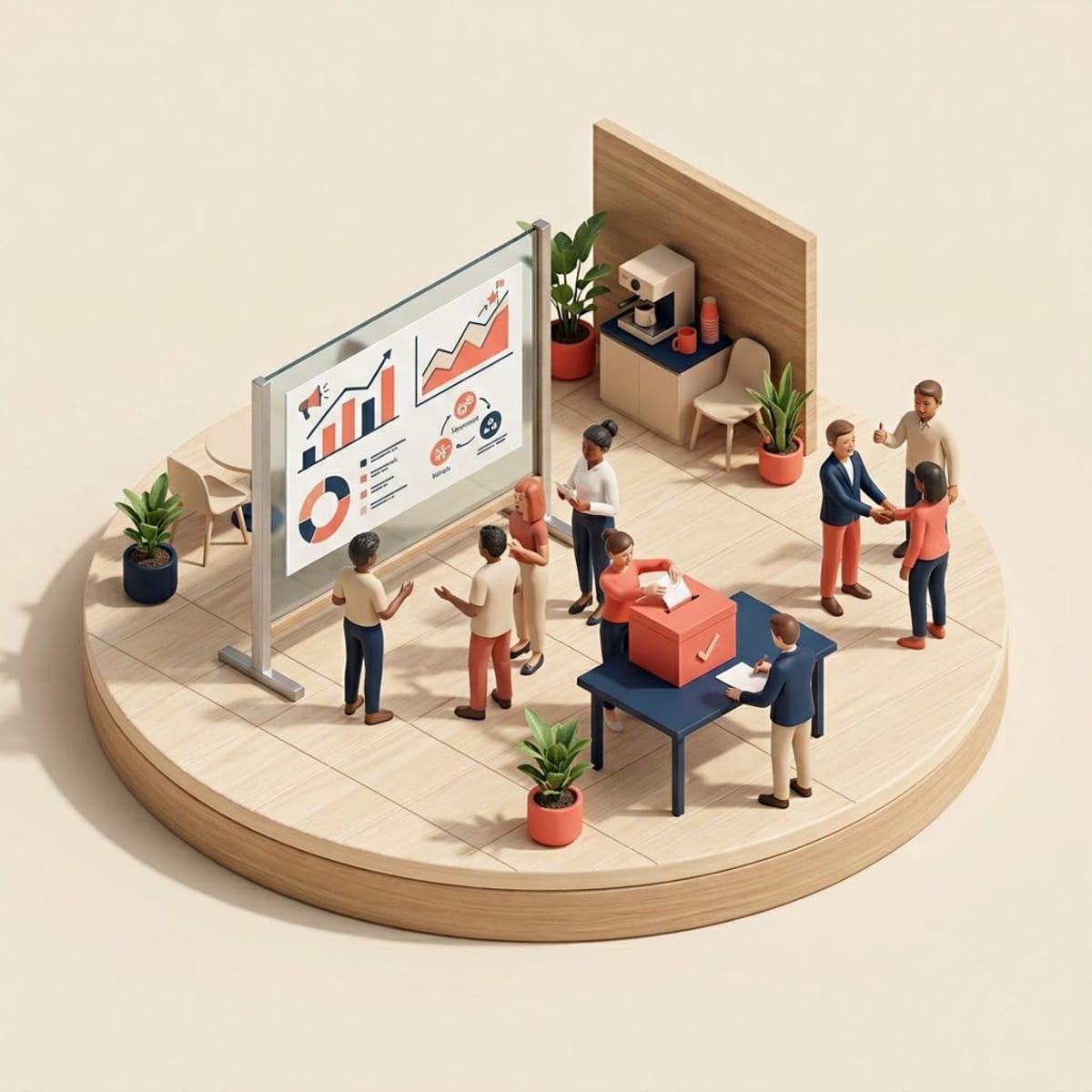
You can't improve what you don't measure. Combine hard data with qualitative signals.
Quantitative metrics to track monthly:
- Voluntary turnover rate (aim for under 10% annually)
- Employee Net Promoter Score (eNPS): "Would you recommend working here to a friend?"
- Employee referral rate (happy people refer others)
- Time to fill open roles (strong cultures attract candidates faster)
Monthly pulse survey questions (keep it short—4 questions max):
- "How supported do you feel by your manager?"
- "Do you feel comfortable sharing honest feedback?"
- "Are you excited about our company's direction?"
- "Do you have what you need to do your best work?"
Exit interviews are goldmines. Track patterns in why people leave, what they valued most, and what would have kept them. Cross-reference with your retention strategy to close gaps.
Build a simple dashboard—even a shared spreadsheet—tracking these signals monthly. Trends matter more than individual data points.
Common Mistakes That Kill Culture
1. Assuming culture develops naturally. Culture forms whether you're intentional or not. Without deliberate effort, you'll default to whatever patterns emerge first—often the loudest voice or the worst habits.
2. Values that sound good but aren't lived. Generic values like "integrity" and "teamwork" create cynicism when daily behavior contradicts them. Define values based on real decisions you've made, not aspirational posters for the break room.
3. Leadership that doesn't model it. Executives who talk about work-life balance while sending Saturday night emails undermine every culture initiative. People watch what leaders do—not what the handbook says.
4. Hiring only for skills. One cultural misfit can damage small team dynamics dramatically. The brilliant engineer who belittles teammates will cost you more in turnover than they save in output.
5. Treating culture as one person's job. Culture is created by everyone's daily actions and decisions. Make it a shared responsibility. Leadership sets the example, managers reinforce it, and every team member contributes to it.
Tools That Support Workplace Culture
Technology should reinforce cultural values and make positive behaviors easier—not replace genuine human connection.
Communication: Slack or Teams with purposeful channels—#wins for celebrating achievements, #feedback for suggestions, #random for human connection. Loom for async video updates that maintain personal warmth across distributed teams.
Performance and growth: Regular check-ins through your performance review system, transparent OKR tracking, and dedicated learning budgets for professional development. These signal that you invest in people, not just output.
Recognition and connection: Peer recognition in a shared channel takes minutes but builds morale for days. Platforms like Tiny Team combine people management with culture tools in one place. A company timeline where everyone can celebrate milestones publicly. A team calendar that makes PTO visible and respected—because work-life balance shouldn't just be talk.
Feedback: Culture Amp or TinyPulse for pulse surveys. Anonymous channels for sensitive topics. The specific tool matters far less than the consistency of using it. Pick one approach and commit to it for at least six months before evaluating whether to switch.
Frequently Asked Questions
How long does it take to build a strong workplace culture?
Foundational elements take 3-6 months of consistent effort for small teams. You'll see initial shifts in communication and collaboration within 4-6 weeks, but embedding lasting norms requires sustained focus over multiple quarters. Culture evolves continuously—the goal isn't to "finish" but to create systems that reinforce positive patterns as your team grows.
Can you change a toxic workplace culture?
Yes, but it demands leadership commitment and patience. Small teams have advantages—fewer people to align and less bureaucratic resistance. Leadership must model new behaviors consistently for months, change systems that reward old behaviors, and communicate frequently about why the shift matters. Expect 6-18 months for significant cultural transformation.
What's the biggest cultural challenge for remote teams?
Informal relationship building and spontaneous collaboration that happens naturally in offices. Solutions include scheduled informal interaction time (virtual coffees, non-work channels), thorough documentation for transparency, regular video calls alongside text communication, and intentional onboarding programs that help new hires understand unwritten team dynamics.
How do you maintain culture when you can't afford competitive salaries?
Focus on non-monetary elements: professional development opportunities, genuine work-life balance, meaningful work connected to personal values, career growth as the company scales, and consistent recognition. Many professionals will trade some salary for a healthier, more fulfilling environment—especially those who've experienced toxic cultures firsthand.
Should small teams hire a dedicated culture or HR person?
Most teams under 50 people don't need dedicated HR staff. Distribute ownership instead: CEO sets the tone through behavior, managers model it in daily interactions, and a designated culture champion organizes activities and tracks feedback part-time. Consider dedicated HR help at 50+ employees or when culture-related problems exceed your internal capacity to solve.